Sealless Pumps for a Safer and Greener World

Choosing the right conveyor belt can influence productivity, maintenance costs, and workplace reliability. Steel Cord Conveyor Belts are designed for demanding applications where long distances, heavy loads, and high tensile strength matter. Their steel cords provide strong longitudinal support, helping move bulk materials through mining, ports, quarries, and large processing facilities.
The practical advantage becomes clear during daily operation. A properly selected belt can carry heavy ore across steep or extended routes with limited elongation. This stability may reduce take-up movement and support more consistent tracking. Experienced maintenance teams also value predictable belt behavior during inspections and repairs. Small details matter. Splice quality, pulley alignment, belt cleaning, and correct tension can determine actual service life.
However, steel cord construction is not automatically the best answer. Not every site needs it. A rushed specification may create unnecessary expense or complicate field maintenance. Engineers should review belt width, cover grade, impact conditions, material temperature, conveyor length, and loading pattern before making a decision. Manufacturer testing, documented quality controls, and compliance with recognized conveyor standards provide stronger evidence than marketing claims alone.
There is no universal winner. The right belt depends on operating reality. In a wet transfer area, damaged covers may matter more than tensile strength. On a long overland conveyor, low elongation may become critical. Careful selection, professional installation, and scheduled inspections help convert technical potential into dependable performance. Steel Cord Conveyor Belts can offer impressive durability, but only when the complete conveyor system is designed around their strengths and limitations.
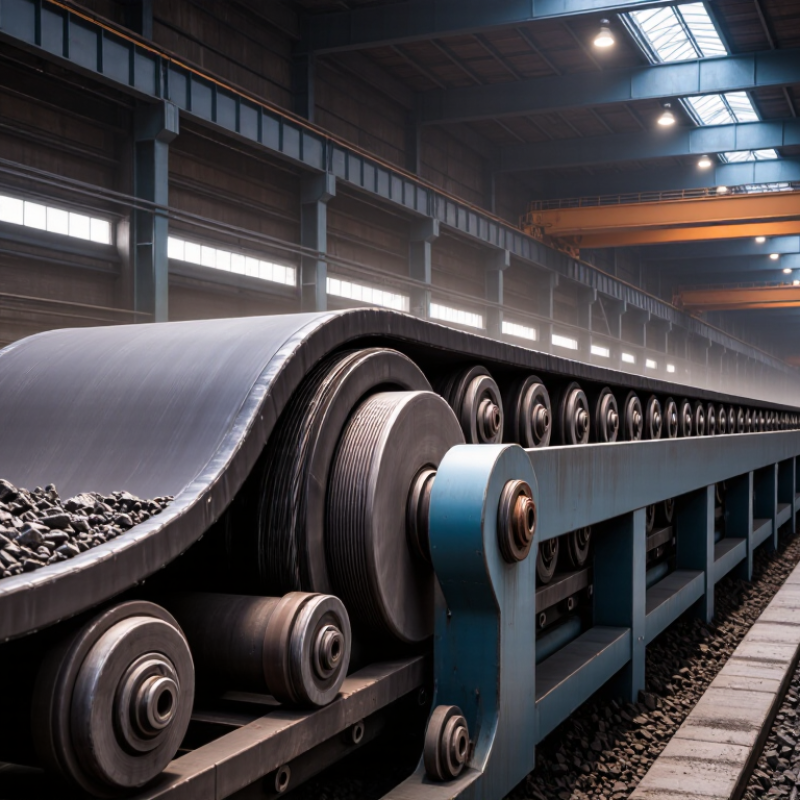
Steel cord conveyor belts use longitudinal steel cables embedded in a rubber carcass. A protective top cover shields the cords from impact, moisture, and abrasive material. The bottom cover supports the belt on idlers and reduces rolling resistance. Edge rubber seals the structure against contamination. ISO 15236-1 defines key construction requirements, including cord arrangement, cover quality, and belt dimensions.
During operation, drive pulleys transfer tension through the cords, not through the rubber covers. This design supports long routes, steep lifts, and heavy loads. Engineering references from CEMA describe belt tension as a balance among material mass, incline, friction, acceleration, and pulley resistance. Common steel cord ratings range from about 1,000 to above 10,000 N/mm, depending on the application and specification. A properly aligned belt can move thousands of tonnes per hour, but capacity depends on width, speed, material density, and loading conditions.
The splice is the critical link. Mechanical force travels through the steel cords, while the rubber layers preserve flexibility and sealing. ISO 15236-2 addresses recommended splice construction and testing principles. Field inspections should check cord exposure, cover cracks, mistracking, and pulley damage. Small defects can grow quickly under repeated tension. The system is powerful, but not forgiving. CEMA guidance also shows that calculation accuracy depends on reliable operating data. In practice, material moisture and real loading often differ from design assumptions, so engineers should review the model after commissioning.
Steel cord conveyor belts deliver high tensile capacity for long, heavily loaded routes. Technical tables from The Conveyor Belt Guide list ratings from about 630 to above 5,400 N/mm. These ratings support wider belts and fewer transfer points. Less hardware can mean fewer impact zones. ISO 15236-1:2017 specifies steel cord belt construction and testing requirements. It also addresses cord spacing, covers, and splice-related properties. Those details matter when a belt runs through dusty, wet, and abrasive conditions.
In operating plants, low elastic stretch is visible during commissioning. The Conveyor Belt Guide reports typical steel-cord elongation near 0.2%, while textile belts commonly reach 1–2%. That difference can reduce take-up movement and support stable loading. It may also simplify tracking, but only when alignment is controlled. A crooked pulley can still destroy a premium belt. CEMA’s Belt Conveyors for Bulk Materials, Seventh Edition, links belt selection with tension, loading, idler spacing, and safety factors. Ignoring one variable produces an elegant calculation and a poor installation. Inspection teams should examine splice geometry, damaged cords, cover wear, and trapped moisture. These are practical failure clues, not paperwork. The weakness is cost. Steel-cord belts demand disciplined splicing and specialized inspection. Choosing solely by tensile rating is a mistake. Route length, lump size, temperature, and repair access deserve equal attention.
Steel cord conveyor belts are chosen for demanding material-handling routes, especially where distance, load, and downtime matter. Their real value appears in places that cannot tolerate frequent belt replacement. In open-pit mines, they carry crushed ore from deep extraction areas to surface processing plants. A single conveyor may cross several kilometers and climb steep gradients. At transfer points, heavy rocks can strike the belt surface. This makes strong reinforcement essential.
Ports and bulk terminals commonly use these belts for coal, limestone, grain, and other dry materials. They help move cargo between unloading equipment, storage yards, and ships. Power stations also rely on them for continuous fuel handling. Quarries, cement plants, and tunnel projects face similar demands. Dust, vibration, sharp fragments, and changing temperatures can test every component. Short routes may not need this level of strength.
Maintenance remains critical. Site technicians should inspect splices, pulley areas, belt edges, and alignment regularly. A small tracking error can create uneven wear within days. Moisture can also reach damaged covers and affect internal steel cords. This detail is easy to overlook. From practical maintenance observations, correct tension often matters as much as belt strength. Steel cord belts are not perfect; they cost more and require careful installation. Yet replacing a failed belt on a remote conveyor can consume several shifts, workers, and transport resources. That trade-off deserves honest evaluation before selection.
| Application or Performance Dimension | Typical Industry Data or Use | Why Steel Cord Conveyor Belts Are Chosen |
|---|---|---|
| Long-Distance Conveying | Commonly selected for conveyor routes extending several kilometres, especially in open-pit mines, overland conveyors, and bulk-material terminals. | The steel-cord carcass provides high longitudinal tensile strength and helps carry heavy loads over long spans with fewer belt joints. |
| High-Capacity Bulk Handling | Used for continuous transport of coal, iron ore, limestone, copper ore, aggregates, clinker, and other high-volume bulk materials. | High-strength belt constructions can support wide belts, deep troughs, and large material loads while maintaining stable operation. |
| Mining Operations | Common in surface mines, underground mines, ore-processing plants, stockyards, and mine-to-plant conveying systems. | Mining systems often require high tensile strength, resistance to heavy impact, and reliable operation under abrasive and demanding conditions. |
| Ports and Bulk Terminals | Used for ship loading and unloading, reclaiming systems, storage yards, and long transfer conveyors handling ore, coal, grain, and aggregates. | High capacity and low belt elongation help maintain consistent loading performance and reduce the need for frequent take-up adjustments. |
| Power Generation | Applied in coal-fired power stations and other facilities where fuel or mineral materials must be transferred between storage, crushing, and processing areas. | Steel cord belts can be specified with covers and compounds suitable for abrasion, heat, oil, or fire-related service requirements. |
| Cement and Limestone Plants | Used in limestone quarrying, raw-material handling, clinker transport, and long conveyors connecting quarry and plant operations. | The belt combines high tensile performance with good dimensional stability for abrasive materials and continuous-duty conveying. |
| High-Tension Conveyor Systems | Suitable for systems requiring higher belt tension than conventional fabric belts can efficiently provide, including steep or heavily loaded routes. | Steel cords carry the main tensile load, allowing the belt to handle demanding pulling forces with comparatively low elastic stretch. |
| Low Elongation Requirement | Steel cord belts generally have lower longitudinal elongation than multi-ply textile belts; actual values depend on belt construction and operating tension. | Lower elongation supports more stable belt tracking, more compact take-up arrangements, and improved control on long conveyors. |
| Belt Width and Strength Selection | Belt widths and tensile ratings are selected according to capacity, belt speed, material density, conveyor length, lift, trough angle, and safety factors. | The steel-cord design offers a broad range of tensile ratings, allowing engineers to match the belt to the calculated system tension rather than relying on a single standard size. |
| Splicing and Maintenance | Steel cord belts normally use vulcanized splices. Splice quality, alignment, inspection, and correct curing are essential for service reliability. | A properly designed and installed splice can preserve the belt's tensile performance, but specialized equipment and trained technicians are required. |
| Impact and Abrasion Conditions | Used beneath crushers, screens, and loading points when the belt is specified with suitable cover thickness, rubber grade, and impact protection. | The steel-cord carcass provides strong longitudinal reinforcement, while the cover rubber protects against impact, cutting, and abrasion. |
| Operating Limitations | Requires correct pulley diameters, take-up design, alignment, loading conditions, cover selection, and routine inspection to prevent damage and fatigue. | Proper system design is necessary because steel cord belts are high-performance components and may be less forgiving of severe misalignment or improper splicing. |
Note: The applications and performance descriptions shown are typical industry practices. Final belt selection should be based on conveyor calculations, material characteristics, environmental conditions, applicable safety requirements, and the belt manufacturer's technical specifications.
Why Choose Steel Cord Conveyor Belts?
Factors to Consider When Choosing a Steel Cord Conveyor Belt
Choosing a steel cord conveyor belt starts with operating conditions, not belt strength alone. Consider conveyor length, lift height, material density, impact energy, and daily running hours. The USGS Mineral Commodity Summaries 2024 estimates global iron ore production at about 2.5 billion metric tons in 2023. Such volumes demand stable tension control and reliable splicing.
Belt rating must match the calculated maximum tension. ISO 5048 provides methods for estimating conveyor power and resistance. CEMA’s Belt Conveyors for Bulk Materials also highlights loading, idler spacing, pulley diameter, and take-up movement. A higher rating is not always better. It can increase cost, pulley requirements, and installation difficulty. One field lesson is easy to miss: poor alignment can damage even a premium belt. This deserves more attention.
Tips: Check lump size and drop height before selecting the cover grade. Review the splice design with the maintenance team. Measure pulley diameters against the belt manufacturer’s technical limits. Leave room for temperature, moisture, and starting loads. Keep inspection records for edge wear, cover cracks, and cord exposure. A practical selection may still need revision after the first operating season.
Factors to Consider When Choosing a Steel Cord Conveyor Belt
How to read the chart: Steel cord conveyor belts are selected according to the required longitudinal belt strength. Common strength classes range from approximately ST 1000 to ST 5000, with higher values supporting longer conveyors, higher material loads, and more demanding conveying conditions.
Key selection factors: Consider belt strength, conveyor length and incline, material density and lump size, impact energy, operating temperature, cover grade, belt width, splice design, and maintenance requirements. Steel cords provide low elongation and high tensile strength, which can help reduce take-up travel on long-distance conveyors.
Steel cord conveyor belts are chosen for long, high-tension routes, but their service life depends heavily on maintenance discipline. CEMA’s Belt Conveyors for Bulk Materials, 7th Edition, recommends checking belt tension, loading conditions, pulley alignment, and take-up travel during routine inspections. These details matter. A small mistracking problem can gradually damage belt edges, covers, and splice areas.
In practical operations, well-maintained steel cord belts are often planned for five to ten years of service. Harsh routes may shorten that period to two to five years. Abrasive ore, sharp impact, moisture, and frequent overloads accelerate wear.
ISO 15236 guidance emphasizes correct belt construction, splice design, and inspection practices. Technicians should examine exposed cords, cover cracks, longitudinal cuts, and splice bulges. Ultrasonic or magnetic inspection can identify internal cord damage before a visible failure occurs. Do not rely only on surface appearance.
Maintenance should include weekly visual checks and scheduled measurements of cover wear, belt elongation, and splice condition. Conveyor safety guidance from the U.S. Mine Safety and Health Administration also stresses guarding, emergency stops, and safe inspection procedures. These controls protect people and reduce avoidable downtime.
A perfect schedule does not exist. Dust, seasonal moisture, and changing material size can invalidate yesterday’s assumptions. Operators should record repair dates, failure locations, loading changes, and inspection findings. That record often reveals the real service-life pattern more clearly than a brochure or initial estimate.



