Sealless Pumps for a Safer and Greener World

Global gas projects demand materials that can handle pressure, ground movement, and long operating periods. PE Gas Pipes are valued for their flexibility, corrosion resistance, and welded joints, which can reduce leak paths when installation and quality controls are sound. They are also relatively light. Crews can handle pipe coils and sections more easily than many rigid alternatives, especially across uneven sites.
Tony Radoszewski, a longtime plastics-pipe industry leader, has highlighted polyethylene’s established role in gas distribution. A careful summary of that perspective is: “A proven service history matters, but every project still needs engineering suited to its conditions.” This is a paraphrase, not a verbatim quotation. That distinction matters. Pipe selection should match the required pressure, gas, temperature range, design life, and local specifications. Engineers should also review joining procedures, inspection plans, and the experience of installation crews. A smooth-looking weld is not proof of a sound joint.
The site tells its own story. A trench may contain sharp stones, wet soil, or tight bends that affect installation choices. PE Gas Pipes can offer practical advantages, but they are not a shortcut around careful design. Compare suppliers’ traceability records and documented test data. Confirm that fittings and equipment are compatible. Small oversights can become expensive later. Even a good material has limits. A reliable project begins with evidence, not assumptions.
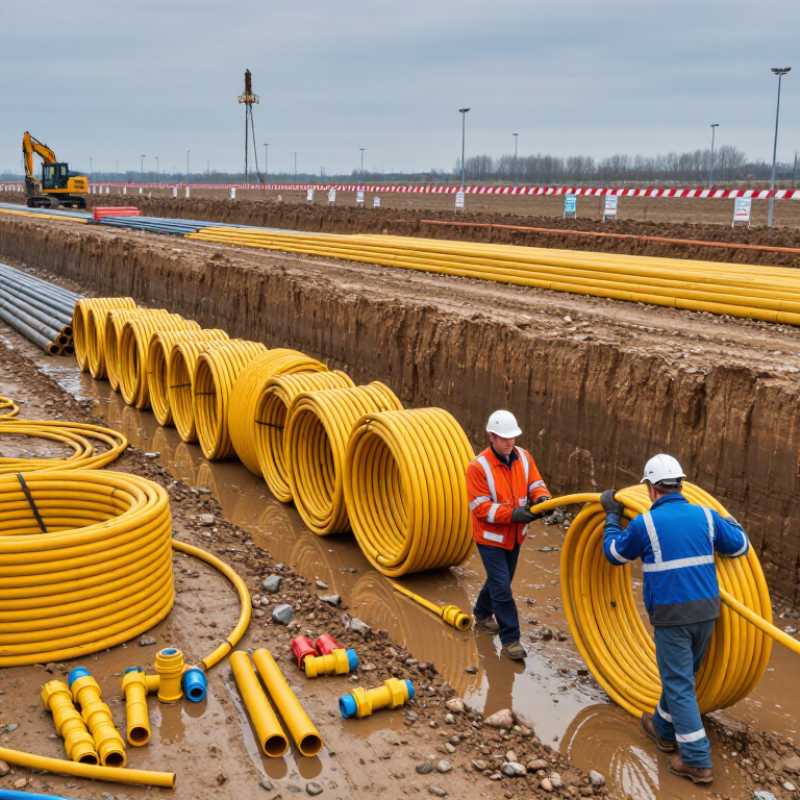
PE gas pipes are pressure-rated pipes made from polyethylene, a flexible thermoplastic. They carry natural gas through distribution networks, from utility mains to service connections. Their flexibility helps installers route pipe around bends and obstacles, often with fewer joints than rigid systems. Fewer joints can mean fewer potential leak points. Still, installation quality matters.
In practice, crews prepare the pipe ends and join compatible sections using approved fusion methods or mechanical fittings. They check alignment, fusion conditions, and pressure-test results before the line enters service. PE is corrosion-resistant and relatively light, which can simplify handling in a trench. It is not suitable for every temperature, pressure, or above-ground exposure; project specifications must determine where it belongs.
The U.S. Pipeline and Hazardous Materials Safety Administration’s 2023 annual gas-distribution data records more than 1.3 million miles of distribution mains nationwide. That scale helps explain why durable, maintainable pipe materials matter. The data describes the network, not a guarantee that any PE installation will perform well. Soil movement, poor joining, and damage during excavation still deserve attention. Small details count. The Plastics Pipe Institute’s PE-piping guidance likewise emphasizes material selection, joining practice, and handling as parts of a reliable system.
PE gas pipes are used in gas distribution networks. Their material class is one factor engineers consider when selecting a pipe for a project.
Minimum Required Strength (MRS) classification: PE80 is 8 MPa and PE100 is 10 MPa, as defined by ISO 12162. MRS is a material classification, not a pipe’s allowable operating pressure; pressure design also depends on factors such as pipe dimensions, SDR, temperature, and applicable regulations.
Polyethylene (PE) combines flexibility with resistance to corrosion, useful traits for buried gas lines crossing uneven ground. Its bendability can reduce the number of fittings, while its low weight makes handling easier at the trench edge. PE100 has a minimum required strength (MRS) classification of 10 MPa under ISO 12162. The classification uses long-term strength evaluation procedures described in ISO 9080. It is a material rating, not a permitted operating pressure. Details matter.
PE also resists many soil chemicals and does not rust like steel. Heat-fused joints can form continuous connections, but only when surfaces are clean and fusion conditions are controlled. The Plastics Pipe Institute’s Handbook of PE Pipe discusses these material and joining characteristics for pressure applications. In practice, scratches, poor handling, or unsuitable installation conditions can undermine the advantages. PE is not a set-and-forget material. Project teams still need to check temperature, pressure, pipe dimensions, and local ground conditions against the applicable design requirements. A flexible pipe can accommodate movement, but that does not make every route or support arrangement suitable.
Why Choose PE Gas Pipes for Global Projects?
How Do PE Gas Pipes Support Safety and Regulatory Compliance?
PE gas pipes can help create reliable distribution networks when the pipe, fittings, and installation method suit the project. Their flexibility can make routing around bends easier, while heat-fused joints can form a continuous connection when trained crews follow approved procedures. Safety depends on the whole system, not the pipe alone. Details matter. Correct pressure ratings, compatible fittings, and careful handling all count.
Regulatory requirements differ across countries and project specifications. Before installation, confirm that pipe markings, technical documents, and test records match the applicable local requirements. On site, crews should protect pipe from sharp objects, check fusion equipment, and record joint details. A clean trench bed also helps prevent damage during backfilling. These steps support traceability and make later inspections more practical. Still, paperwork cannot replace sound workmanship, and inspection methods may vary by project.
Tips: Keep a clear record of pipe batches, fusion settings, operator checks, and pressure tests. Inspect pipes before lowering them into the trench. If documentation is incomplete, pause and resolve the gap before covering the line. A rushed job can leave questions that are difficult to answer later.
| Safety and compliance dimension | How PE gas pipes support it | Project checks for global use |
|---|---|---|
| Applicable product standards | PE gas piping systems are covered by standards such as ISO 4437 and EN 1555. ASTM D2513 covers thermoplastic gas pressure pipe, tubing, and fittings in its applicable scope. | Confirm the standard and edition accepted by the local regulator, utility, and project specification. Requirements can differ between jurisdictions. |
| Pressure and SDR selection | PE pipe is manufactured in defined material grades and dimensions. Its allowable operating conditions depend on factors including material properties, pipe dimensions, temperature, and the applicable design rules. | Verify the required pressure class or maximum operating pressure, SDR, material designation, temperature limits, and design factors against local codes and project calculations. |
| Joint integrity | Butt fusion and electrofusion can create permanent joints when the specified materials, equipment, preparation, and joining procedures are used correctly. | Use approved joining procedures and appropriately qualified personnel. Record relevant jointing parameters and carry out inspections or testing required by the governing rules. |
| Corrosion and external damage | PE is not subject to electrochemical corrosion in the same way as metallic pipe. It still requires protection from mechanical damage and any exposure conditions identified by the design. | Assess handling, storage, installation, backfill, impact risks, and exposure conditions. Follow local requirements for marking, location, and protection of buried services. |
| Identification and traceability | Pipe markings and supporting documentation can help identify characteristics such as material, dimensions, pressure designation, and applicable standard, subject to the relevant specification. | Check required markings, batch or lot records, certificates, and documentation before installation. Do not rely on color alone to establish suitability or compliance. |
| Installation and commissioning | PE pipe systems can be installed using methods permitted by the project design and local rules. Correct installation and commissioning are essential to system safety. | Follow the authority-approved installation, inspection, pressure testing, and commissioning procedures. Apply the locally required test medium, limits, and acceptance criteria. |
| Cross-border project control | A consistent project specification can coordinate pipe, fittings, joining methods, records, and inspection across different work packages. | Map each location to its applicable laws, adopted standards, utility rules, and approval process. Confirm that the complete system—not only the pipe—meets local requirements. |
Compliance depends on the applicable jurisdiction, project design, and installation. Confirm current requirements with the relevant authority and project engineer.
PE gas pipeline efficiency starts with matching the installation method to the ground. Open-cut trenching gives crews direct access for bedding, alignment, and inspection. It can work well in open corridors, but traffic, paving, and deep excavations may slow progress. Keep the trench clean and support the pipe evenly; small stones can create damaging point loads.
In built-up areas or beneath roads, horizontal directional drilling can reduce surface disruption. Crews can install a continuous PE pipe string with fewer joints along the route. The trade-off is real: drilling may save restoration work, but it is not automatically faster. Soil conditions, bore planning, and pullback limits matter. That choice deserves a second look.
Joint quality is just as important as route choice. Butt fusion or electrofusion should follow approved procedures, using clean, dry pipe surfaces and correctly prepared equipment. Allow joints to cool as specified before handling or loading them. Small details matter. A practical sequence includes checking pipe condition, documenting fusion parameters, and completing required inspection and pressure testing. Follow the project design and applicable local requirements. Even careful crews can face delays when weather, access, or unexpected ground conditions change the plan.
Across hot deserts, frozen ground, and coastal corridors, PE gas pipes offer useful flexibility. Their low weight can ease handling on remote sites, while fused joints create continuous connections with fewer potential leak paths than many mechanical joints. The Plastics Pipe Institute’s Handbook of PE Pipe describes polyethylene’s corrosion resistance and ability to accommodate ground movement. That matters where soils shift or moisture varies. Still, installation quality is decisive. A poorly prepared fusion joint can undermine the pipe’s advantages.
Material ratings also help planners compare projects. Under ISO 12162, PE100 has a minimum required strength classification of 10 MPa, based on long-term hydrostatic testing defined by ISO 9080. This is a material classification, not a safe operating pressure; design limits depend on pipe dimensions, temperature, gas, and applicable standards. In cold regions, flexibility can help manage ground movement, but handling and joining procedures still need temperature-aware controls. In hot climates, elevated operating temperatures can reduce allowable pressure. Details matter. Route surveys, pressure design, and trained fusion crews should guide selection. One limitation deserves honest attention: PE is not automatically the best choice for every above-ground exposure or operating condition. Recheck the assumptions.



