Sealless Pumps for a Safer and Greener World

Global buyers need more than a long supplier list when sourcing Square Tube products. They need consistent dimensions, dependable steel grades, clear documentation, and practical export experience. A polished website is useful, but it cannot replace mill records, inspection reports, or responsive communication.
Professor Jeffrey A. Packer, a recognized hollow structural section specialist, has said, “The design of hollow section connections is often more complex than the member design itself.” His observation also matters during procurement. Tube geometry, wall thickness, corner radius, welding quality, and surface treatment can affect fabrication and structural performance. Small deviations may create expensive problems on a busy production line.
This guide examines the top Square Tube suppliers serving global buyers. It considers manufacturing capacity, product range, quality systems, certifications, packaging, lead times, and after-sales support. It also separates manufacturers from traders, because the distinction is sometimes blurred. That can confuse buyers.
Real sourcing work is rarely perfect. A supplier may offer excellent prices but limited customization. Another may provide strong certificates yet struggle with delivery during peak seasons. Buyers should compare samples, verify test documents, and discuss tolerances before placing large orders. Factory audits can reveal details that brochures hide, such as rust marks, uneven bundling, or unclear labeling.
The strongest supplier is not always the biggest one. It is the company that fits the project’s technical, commercial, and logistical needs. This article provides a practical starting point for making that judgment. However, buyers should still conduct independent verification before signing contracts.
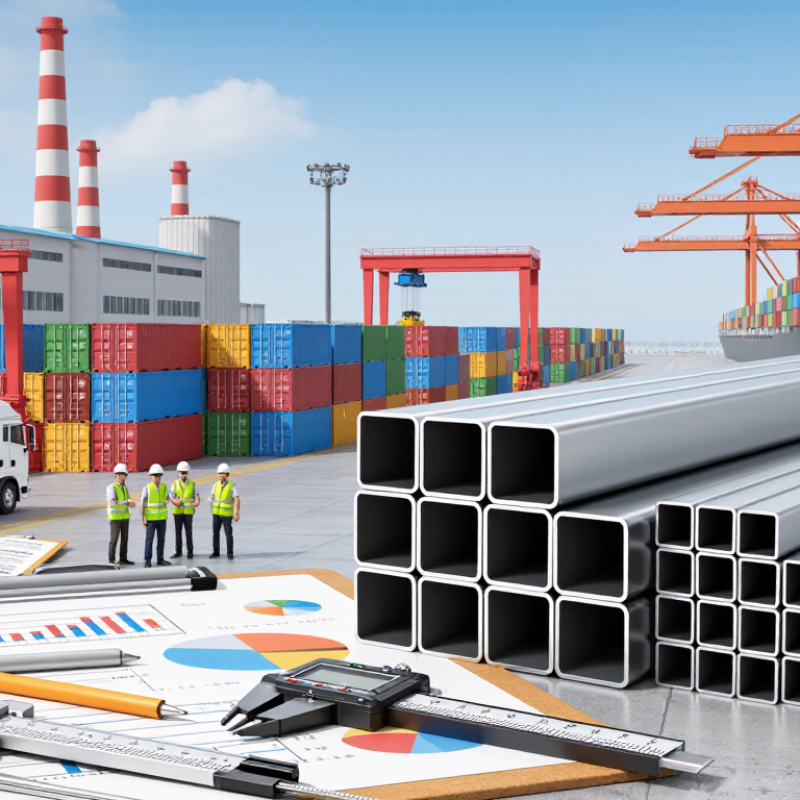
Global buyers should compare square tube suppliers against documented standards, not catalog promises. ASTM A500/A500M covers cold-formed welded and seamless carbon steel structural tubing. Grade B requires at least 46 ksi yield strength and 58 ksi tensile strength. Grade C raises these values to 50 ksi and 62 ksi. Mill certificates should show chemistry, dimensions, heat numbers, and test results.
EN 10219-1 uses different grade language. S235JRH, S275J0H, and S355J2H specify minimum yield strengths of 235, 275, and 355 MPa. Their typical tensile ranges are 360–510, 410–560, and 470–630 MPa. Impact requirements also vary with temperature. That detail matters for exposed frames, platforms, and winter shipments. Check weldability, corner radius, wall-thickness tolerance, and section straightness. Small deviations can complicate automated fabrication.
The World Steel Association reported approximately 1.89 billion tonnes of crude steel production in 2023. This scale supports broad sourcing, but it does not prove supplier reliability. Buyers should request recent third-party inspection records and verify batch traceability. ISO 9001 certification helps, though it cannot replace product testing. Production experience matters here. A supplier that understands both ASTM and EN documentation can reduce conversion errors between ksi and MPa. Still, grade comparisons are not perfectly interchangeable. I would treat any “equivalent grade” claim cautiously and confirm the project specification with an independent engineer.
What Are the Top Square Tube Suppliers for Global Buyers?
World crude steel output reached 1.892 billion tonnes in 2023, according to industry statistics. This scale shows a deep supply base for square tubes. However, production volume alone cannot identify the right supplier. Global buyers should examine forming equipment, steel grades, wall thickness control, and export experience. A reliable supplier should provide mill test certificates, dimensional reports, and clear traceability from coil to finished tube.
The strongest suppliers usually combine stable capacity with strict inspection procedures. Check outside dimensions, corner radius, straightness, weld quality, and coating uniformity. Ask for samples before approving a large order. Packaging also matters. Bundles need strong straps, moisture protection, and readable labels for long sea transport. Delivery promises can sound precise, but port congestion and raw material changes may affect schedules. This part is often underestimated.
Tips: Compare at least three quotations using the same specifications. Confirm tolerances in writing, not through informal messages. Request recent inspection records and production photos. A lower price may hide thinner walls or weaker packaging. That mistake can become expensive. Buyers should also review payment terms, loading capacity, and replacement procedures for damaged goods. No supplier is perfect, and even a careful evaluation may miss a logistical weakness. Recheck critical details before production starts.
The leading steel-producing markets represent the largest upstream supply pools for global square tube sourcing. World crude steel output reached approximately 1.888 billion tonnes in 2023.
Data: World Steel Association, 2023 crude steel production. Values are shown in million tonnes; country figures refer to national steel output, not individual suppliers.
Global buyers should match the supplier type to the project’s risk, volume, and delivery window. Mills offer the strongest control over chemistry, welding practice, and production scheduling. They suit repeated orders and strict specifications, but minimum quantities can be demanding. Stockists hold common square tube sizes nearby. This can shorten delivery and reduce factory-direct complexity. However, batch age, surface condition, and replacement availability require inspection.
Exporters coordinate international sourcing, documentation, freight, and customs processes. Their value depends on transparent mill identification and accurate packing lists. Regional distributors add local inventory, technical support, and faster claims handling. They may charge more, but that premium can protect a shutdown-prone project. World Steel Association’s World Steel in Figures 2024 reports about 1.89 billion tonnes of crude steel production in 2023. This scale confirms broad supply capacity, not automatic product consistency.
Ask every supplier for a recent EN 10204 3.1 inspection certificate, dimensional tolerances, grade confirmation, and bundle photographs. Check wall thickness at several points, especially near cut ends. Confirm whether quoted weight includes packaging. It often does. Export quotations should state Incoterms, port, validity, lead time, and responsibility for damage. OECD steel market analysis continues to highlight global capacity pressure and uneven demand. Therefore, a low price may reflect excess inventory rather than superior efficiency. I would compare at least three offers. Price alone is a weak decision tool. Supplier records can still be incomplete, so buyers should verify heat numbers against the mill certificate before payment.
Global buyers should screen square tube suppliers through documented performance, not attractive catalogs. In procurement reviews, I check whether the steel consistently reaches a minimum 355 MPa yield strength. A single test result proves little. Ask for heat numbers, chemical composition, tensile results, and traceable Mill Test Certificates (MTCs). The certificate should match the delivered bundle, not merely describe a standard grade.
Tips: Request recent MTC samples before placing an order. Compare tube dimensions with the agreed specification, including outside size, wall thickness, corner radius, straightness, and length. Tolerances can affect welding fixtures and structural alignment. Ask how measurements are taken. Calipers, ultrasonic gauges, and calibrated tools should have inspection records. Small gaps in documentation matter.
A reliable supplier also explains nonconforming-product procedures and packing controls. Tubes may arrive with bent ends, surface rust, or mixed heat numbers if handling is weak. Photograph bundles during loading and record labels before shipment. Independent inspection can confirm random dimensions and yield strength before dispatch. It costs more, but rework costs more. I have seen technically strong suppliers lose trust through incomplete records. That weakness deserves attention, even when the steel itself appears excellent.
Quality Screening: Verify 355 MPa Yield Strength, Tolerances, and MTCs
| Screening Profile | Typical Product Scope | Required Steel Grade | Yield Strength Verification | Dimensional Tolerance Check | MTC Requirement | Buyer Qualification Status |
|---|---|---|---|---|---|---|
| Profile A | Carbon steel square and rectangular hollow sections for general structural applications | S355J2H to EN 10219-1 or equivalent specification | Minimum 355 MPa for wall thickness up to 16 mm; verify test results by heat number | Outside dimension generally within ±1%, with a minimum tolerance of ±0.5 mm under EN 10219-2 | EN 10204 Type 3.1 certificate showing chemical composition, tensile properties, heat number, and dimensions | Qualified after document review |
| Profile B | Heavy-wall square tubes for frames, platforms, machinery supports, and construction components | S355JR or S355J2H; grade designation must be stated on the purchase order | 355 MPa applies to thickness up to 16 mm; the minimum decreases to 345 MPa for thickness above 16 mm up to 40 mm | Verify wall-thickness tolerance, corner radius, squareness, and straightness against the agreed product standard | Original or digitally traceable EN 10204 Type 3.1 MTC required for every production heat | Conditional approval pending sample inspection |
| Profile C | Cold-formed hollow sections supplied in standard and custom cut lengths | S355J2H, with impact-test requirements applicable where specified | Confirm yield strength, tensile strength, elongation, and Charpy impact results where the J2 designation is required | Check section width, height, wall thickness, length, twist, and straightness using calibrated instruments | MTC must link the product to the cast or heat number and include the applicable manufacturing standard | Suitable for technical approval |
| Profile D | Export-oriented supplier offering mill test documentation and third-party inspection support | S355 structural hollow section or an approved ASTM equivalent, subject to buyer approval | Do not accept a generic “355 grade” statement; require heat-specific mechanical test values | Pre-shipment inspection should verify dimensions, visual condition, weld seam quality, and quantity | EN 10204 Type 3.1 preferred; Type 3.2 may be requested when an independent inspection body must validate results | Approved only with independent inspection |
| Profile E | Large-volume supplier for infrastructure, warehouse, agricultural, and fabricated steel projects | S355J0H, S355J2H, or another grade explicitly listed in the technical specification | Confirm thickness-dependent yield strength; for thickness above 40 mm, the minimum may be 335 MPa under EN 10025 grade tables | Require a dimensional inspection report with actual readings rather than nominal dimensions only | MTC, packing list, heat-number traceability, and inspection report should be supplied before shipment | Preferred after quality-system audit |
Global Buyer Verification Notes
Rank 1 goes to audited, mill-linked suppliers offering ASTM A500 or EN 10219 square tubes, ISO 9001 controls, and traceable mill certificates. Their MOQ is often moderate, while lead times commonly range from 20 to 45 days. This balance suits global buyers needing repeat shipments, stable dimensions, and fewer claims.
Rank 2 includes capable stock-based exporters. They can offer shorter lead times, sometimes seven to 20 days, but their available sizes may change weekly. Rank 3 covers low-price traders with flexible MOQs. They may win small trial orders, yet inconsistent coating, packaging, or documentation can erase the price advantage. The ranking remains provisional.
World Steel Association reported approximately 1.89 billion tonnes of crude steel production in 2023, showing the scale of a highly competitive supply market. OECD steel analysis also warns that excess capacity can pressure margins and encourage aggressive quotations. Buyers should compare pricing on an equivalent basis: steel grade, wall thickness, length tolerance, surface finish, packing, and inspection fees.
Incoterms matter more than many spreadsheets show. Under FOB, the buyer controls ocean freight; under CIF, freight visibility may be weaker. UNCTAD’s Review of Maritime Transport confirms shipping carries over 80% of global trade by volume, so port congestion can reshape landed costs. I would not treat the cheapest quote as the winner. A missing test report is expensive. A 60-day lead time can be worse.



