Sealless Pumps for a Safer and Greener World

Choosing the right centrifugal pumps can be challenging. Experts in the field emphasize the importance of understanding your specific needs. Dr. Emily Johnson, a renowned engineer in fluid mechanics, states, "Selecting the right pump is critical to system efficiency." Her words remind us that improper choices lead to inefficiencies.
Many factors influence the right selection. Flow rate, viscosity, and pressure differences are just a few. For instance, a chemical manufacturing plant may require a different pump than an agricultural irrigation system. Understanding what your application needs is key.
Yet, it is easy to overlook details. Users often focus solely on brand reputation or price. This can result in options that do not fit operational requirements. Without careful evaluation, the consequences can lead to higher costs and reduced performance. Every facet of your operation must be considered when selecting centrifugal pumps.

Centrifugal pumps are widely used in various industries. They operate on a simple principle: converting rotational energy to kinetic energy. This process creates pressure that moves fluids effectively. Understanding this basic functionality is crucial when selecting the right pump.
The main components of a centrifugal pump include the impeller, volute, and motor. The impeller rotates, driving fluid through the volute. This design makes it efficient yet sometimes prone to cavitation. Users often overlook the importance of fluid properties, which can affect performance. For instance, viscosity and temperature play significant roles in pump efficiency.
Consider maintenance needs as well. Regular checks can prevent costly breakdowns. It's essential to think about the application. Different environments may require different materials. Sometimes, what works in one situation may fail in another. Reflecting on these details can prevent future issues. Choosing the right centrifugal pump means understanding your specific needs and the pump's functionality. This awareness can lead to more informed decisions.
Choosing the right centrifugal pump is crucial for efficiency. Identifying your specific application requirements is the first step. According to industry research, over 30% of pump failures stem from mismatched applications. Understanding your fluid type, viscosity, and temperature can impact this choice significantly. For instance, corrosive fluids require materials that resist deterioration.
Next, consider the required flow rate and discharge pressure. A report by the Hydraulic Institute highlights that pumps operating below 70% of their best efficiency point can suffer from reduced life expectancy. Other factors like installation environment and energy costs also play a role. The nuances in each application can lead to costly mistakes.
There's often a gap between theoretical calculations and real-world performance. Many users underestimate the impact of system design. Will the pump be operating intermittently or continuously? Regular review and adaptation of these requirements can help you avoid common pitfalls. Ultimately, not addressing these details may lead to unexpected outcomes.
Choosing the right centrifugal pump can be daunting. Various factors affect performance and efficiency. Identifying your specific needs is crucial. This includes the type of fluid being handled. The viscosity and temperature are key considerations. Different applications require different pump designs.
Consider the pump's capacity. It must match your operational requirements. Pump efficiency is another important aspect. An inefficient pump increases energy costs. When assessing efficiency, look into the NPSH (Net Positive Suction Head). This figure helps prevent cavitation and ensures smoother operations.
Here are some tips to guide you:
- Always assess the fluid properties before selection.
- Check the total dynamic head calculation for your system.
- Don't overlook maintenance requirements; complex designs can lead to higher upkeep.
Centrifugal pumps should be easy to service. A complicated design may seem advanced but could become a problem. Sometimes, simplicity translates to better reliability. Reflect on these aspects before your purchase. Taking time to evaluate details pays off in the long run.
When selecting centrifugal pumps, efficiency ratings are crucial. These ratings often range from 60% to 90%. A pump with a higher rating is typically more energy-efficient. Efficiency impacts both operational costs and maintenance needs. For example, a study showed that even a 5% increase in efficiency can save significant energy costs over time.
Performance metrics, such as flow rate and head pressure, are also important. Flow rate is measured in gallons per minute (GPM), indicating how much fluid the pump can move. Common flow rates range from 10 GPM to 500 GPM or more. Head pressure, measured in feet, determines the pump's ability to lift fluids. Often, pumps need a specific head range for optimal performance.
However, not all pumps meet the needed metrics. Selecting the right pump can be complex. A poorly chosen pump could lead to cavitation or reduced lifespan. This necessitates careful consideration of both efficiency and performance metrics. Balancing these factors could prove challenging. Understanding your exact needs is vital for making the best choice. Sometimes, expert consultation can provide clarity.
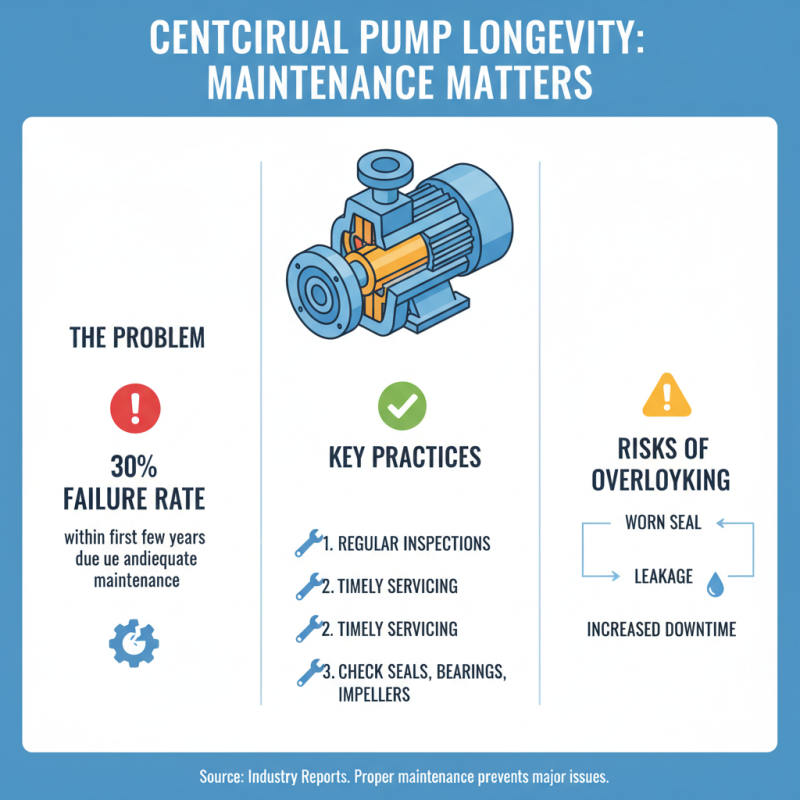
Proper maintenance of centrifugal pumps is crucial for their longevity. According to industry reports, inadequate maintenance can lead to a failure rate as high as 30% within the first few years of operation. Regular inspections and timely servicing are essential. Operators must check seals, bearings, and impellers frequently. A small oversight can lead to major issues. For instance, neglecting a worn seal can cause leakage and increase downtime.
Lubrication plays a vital role in pump lifetime. Data suggests that over 60% of centrifugal pump failures are linked to lubrication problems. Proper lubrication reduces friction and wear. It’s vital to follow the manufacturer’s guidelines on lubricant types, application intervals, and quantities. Even the best pumps need attention. A proactive maintenance program can identify potential problems early. This reduces repair costs and prolongs service life.
Monitoring operating conditions is equally important. Vibration, temperature, and pressure fluctuations can signal trouble. Regular data collection and analysis can help detect irregularities. Yet, not all operators are equipped to do this effectively. Some overlook routine checks, believing everything is fine. This mindset can lead to unexpected failures. Routine and diligent maintenance can make a significant difference, and every detail counts.