Sealless Pumps for a Safer and Greener World

Global buyers need more than a catalog label when comparing 2026 Spring Tensioner options. A Spring Tensioner may control belt movement, stabilize chain tension, or maintain pressure inside compact machinery. Its performance depends on load capacity, working travel, fatigue resistance, temperature range, and installation space. These details become critical when equipment operates continuously in dusty factories, humid ports, or cold distribution centers.
Industry reports show why this category deserves closer attention. The International Energy Agency’s Global EV Outlook 2025 reported more than 17 million electric cars sold worldwide in 2024. Electrification is changing accessory drives, service schedules, and tensioner requirements. Grand View Research’s automotive timing belt market analysis also identifies replacement demand, vehicle production, and material development as important market drivers. These reports do not provide one universal tensioner formula. They do, however, show a clear need for application-specific selection.
The 2026 buyer should compare coil-spring, torsion-spring, constant-force, and spring-assisted hydraulic designs. Coil models often suit compact belt systems. Torsion designs can provide controlled rotational movement. Constant-force types support longer travel with steadier output. Hydraulic-assisted units may reduce vibration, but they usually require tighter quality control and higher maintenance awareness.
A neat ranking is impossible.
Real performance depends on the complete assembly, not the spring alone. Buyers should request verified force curves, cycle-life results, corrosion testing, dimensional drawings, and traceable material certificates. ISO 9001 certification supports process consistency, but it does not replace product-level testing. That distinction is easy to miss. This guide compares leading Spring Tensioner types through practical engineering evidence, supplier reliability, and total operating risk.
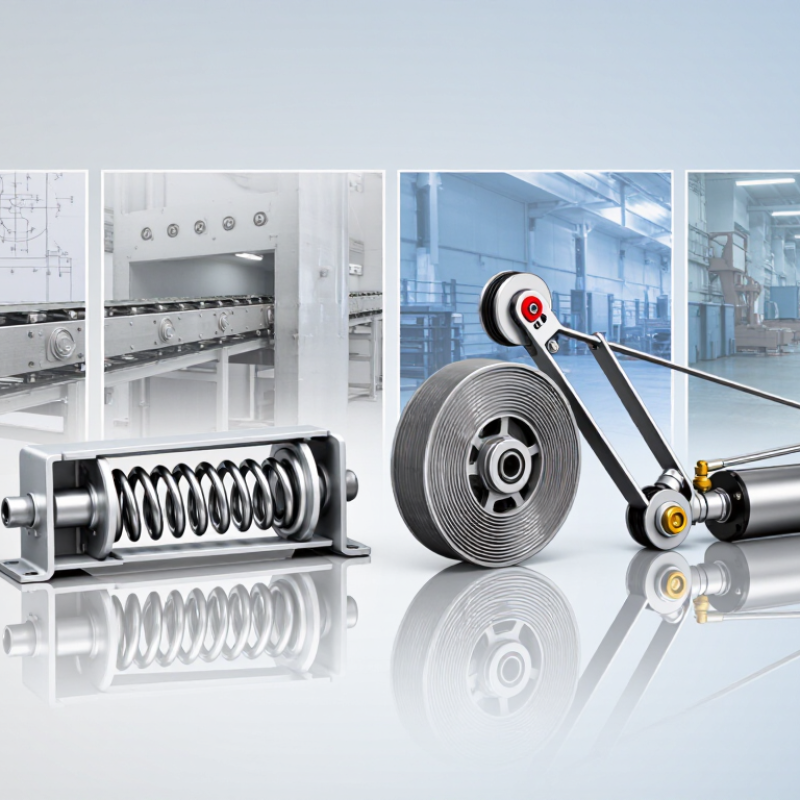
A spring tensioner is a mechanical device that keeps steady force on belts, chains, cables, or moving assemblies. It usually combines a spring, tension arm, pulley, guide, and mounting base. When the system stretches, vibrates, or changes temperature, the spring stores and releases energy. This movement helps maintain suitable tension without constant manual adjustment.
Common designs include compression, extension, torsion, and constant-force tensioners. A torsion model rotates around a pivot. An extension model pulls against increasing load. Compression designs push components into position. In practical maintenance, the correct type depends on load, travel, speed, temperature, and installation space. Too much preload can damage bearings. Too little tension can cause slipping or unstable motion. The choice is not always obvious.
Tips: Measure the working load, spring rate, stroke, and available space before purchasing. Check fatigue performance, corrosion resistance, operating temperature, and technical documents. Ask for test data when the application runs continuously. A small mistake in pretension can become a large maintenance cost. Installation alignment matters too. I have found that buyers often focus on price first, then discover unsuitable spring behavior later. That habit deserves reconsideration. A reliable tensioner should match the whole motion system, not just one component.
In 2026, automatic torsion-spring tensioners are likely to lead global markets. They maintain belt load as systems expand, contract, or wear. This design suits conveyors, agricultural equipment, and compact manufacturing lines. It also compensates for small alignment changes during daily operation.
Small errors matter.
For high-speed machinery, damped spring tensioners should gain attention. Their controlled movement reduces belt vibration and sudden load changes. Buyers should examine spring fatigue data, adjustment range, and bearing protection.
Constant-force tensioners may grow in demand where stable pressure is essential. They deliver consistent force across a wider travel distance. However, their initial cost can discourage smaller operations.
Heavy-duty compression-spring tensioners remain practical in dusty and demanding environments. They tolerate frequent starts, temperature changes, and moderate shock loads.
In food, packaging, and clean production areas, corrosion-resistant materials become more important. Material certificates and repeatable test records improve purchasing confidence.
A common mistake is selecting by spring force alone. Maintenance audits often reveal poor pulley alignment behind repeated failures.
The better choice considers load, speed, contamination, installation space, and service access.
Still, no type performs perfectly everywhere. Testing conditions are rarely identical to factory floors.
2026 Top Spring Tensioner Types for Global Buyers
How Do Spring Tensioners Differ by Design, Load, and Adjustment?
Spring tensioners differ mainly in movement, force delivery, and service access. A compression-spring design pushes an arm outward, keeping belt or chain tension stable. A torsion-spring model uses rotational force around a pivot. It often fits compact assemblies with limited installation space. Extension-spring tensioners pull components together, but exposed coils may collect dust and moisture. They are not ideal for every outdoor application.
Load ratings need more than a single maximum number. Check the working load, preload, travel range, and fatigue performance. A tensioner handling a 300-newton static load may fail under repeated shock loads. Measure the force near the actual operating position. Small angle changes can alter the spring force. Temperature also matters. Cold conditions may increase stiffness, while heat can reduce long-term spring performance.
Adjustment methods affect installation and maintenance. Threaded adjusters provide precise manual control and suit fixed machine layouts. Eccentric mounts allow quick alignment changes but offer limited fine tuning. Automatic tensioners compensate for wear and thermal expansion with less operator input. However, their movement must match the system’s real travel requirements. Too little travel creates slack; too much travel may overload bearings. In field inspections, I would record belt deflection, spring position, and mounting torque before selecting a replacement. That process takes longer. It can prevent a confident but incorrect choice.
2026 Top Spring Tensioner Types for Global Buyers
Where Are the Main Spring Tensioner Types Used?
Extension spring tensioners suit systems needing pull force over a defined travel. They appear in conveyor take-up units, garage mechanisms, agricultural equipment, and cable controls. Designers often add hooks, eyes, or threaded ends for adjustment. A small conveyor line may use one spring to maintain belt contact as the belt stretches. It looks simple. It is not.
Compression spring tensioners work when the load pushes inward. They are common in valves, switches, shock-control assemblies, packaging machines, and machine guards. Torsion spring tensioners create rotational force around a shaft. They fit hinges, clamps, brake linkages, roller covers, and counterbalance systems. The correct choice depends on stroke, cycle rate, available space, and fatigue exposure.
The International Federation of Robotics reported 541,302 industrial robot installations in 2023, a 10% yearly increase. This growth supports wider use of compact torsion and compression systems in automated tooling and conveyors. The International Energy Agency reported more than 17 million electric cars sold globally in 2024. That expansion increases demand for spring-loaded connectors, covers, latches, and cable-management assemblies. Yet market growth does not guarantee correct selection. Engineers still need force testing, corrosion checks, and fatigue calculations. Catalog ratings can mislead. Real heat, dust, vibration, and misalignment often reduce service life.
Selecting the right spring tensioner starts with measured load, not catalog appearance. Record minimum and maximum tension, travel, cycle rate, belt width, and mounting angle. The IEA’s Energy Efficiency 2023 report states that electric motor systems consume around half of global electricity. Stable tension is therefore more than a mechanical detail. Excessive preload increases friction, heat, and drive energy. Too little preload causes slip, vibration, and uneven wear. Measure it carefully.
Match the spring type to the motion. Compression springs suit guided pushing loads. Extension springs provide pulling force. Torsion springs control pivoting arms. Constant-force springs can suit longer, nearly uniform travel. For dusty conveyors, shielded housings and corrosion-resistant materials are valuable. Check spring rate, solid height, fatigue life, and operating temperature. ISO 13849-1:2023 supports risk-based machinery safety, but it does not replace a tensioner-specific failure review. Add secondary restraint when a broken spring could release stored energy.
Use supplier test curves, not nominal force alone. The U.S. Department of Energy’s Improving Motor and Drive System Performance report notes that motor systems can represent about 70% of industrial electricity use. Misalignment can quietly increase that burden. Request cycle-test data under your actual stroke and temperature. Check adjustment access with gloves. Check it again after installation. I would not trust a perfect spreadsheet. Dust, operator habits, and unexpected starts change results. Pilot one unit, record force drift and noise, then revise the specification.
How can global buyers select the right spring tensioner? Compare common tensioner types by adjustability, compactness, continuous-force capability, and suitability for dynamic systems.
Selection index: 1 = limited suitability and 5 = strong suitability. The comparison is an engineering-oriented guide, not market-share data. Buyers should verify load, travel, temperature, cycle life, corrosion resistance, and mounting requirements against the final product datasheet.



